

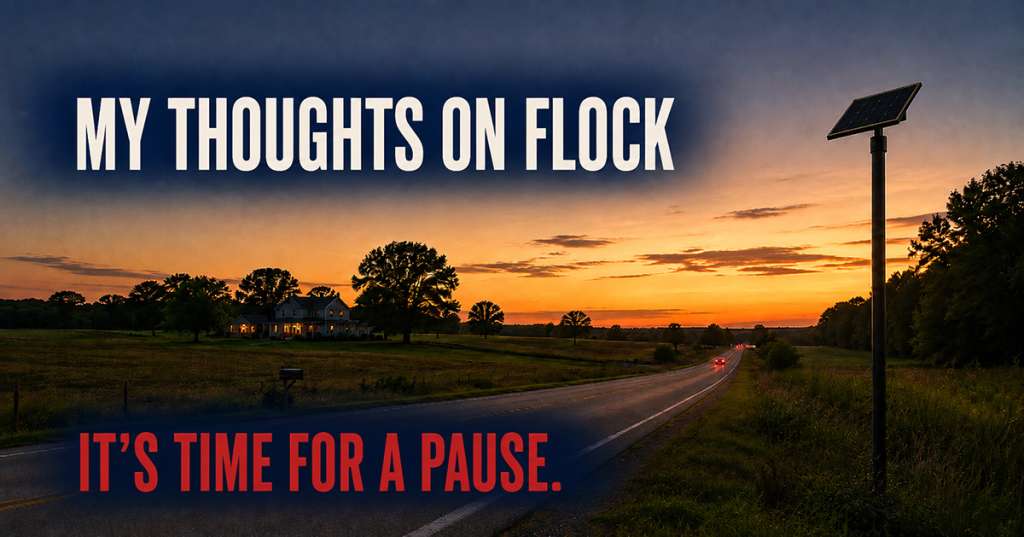
Flock Cameras, Privacy, and Where I Stand
Flock license plate cameras are part of a national debate right now, and that debate has arrived in Platte County. As of today, there are Flock cameras operating in our county. Before this conversation goes any further locally, I want people to understand how I think about this technology.
My background is in technology and information security. I’ve spent decades around data systems — how they’re built, how they’re secured, and how they fail. So when I look at Flock, I’m not reacting to a headline. I’m looking at the architecture — and the privacy controls are the problem.
My position is simple: Platte County should press pause on Flock until enforceable rules exist to protect the privacy of our citizens. Here’s how I got there.
An automated license plate reader is a tool. So is a hammer.
Let me start with what this argument is not. It is not anti–license plate reader, and it is not anti-police. An automated license plate reader, like a hammer, is just a tool. In the right hands, for the right purpose, it builds things — it deters crime, it protects kids, it solves cases. But a hammer in the wrong hands, swung for the wrong purpose, hurts people. The tool was never the issue. The issue is who holds it, what they’re allowed to do with it, and who is watching them.
With Flock, the question of who holds the tool has a surprising answer. It isn’t your police department. It isn’t your city. It’s a private company in Atlanta.
The Flock business model: you don’t own the cameras, and you don’t control the data.
Here is how Flock works, stripped of the marketing. Flock installs automated license plate readers — cameras that photograph and log every plate that drives past, along with the vehicle’s make, color, and distinguishing features, timestamped and location-stamped. Cities and law enforcement agencies don’t buy these cameras. They subscribe to them. Flock owns the hardware, Flock manages the system, and — this is the part that matters — Flock owns and controls the data platform.
Every plate captured in Platte County doesn’t just sit on a server at a local police department. It feeds a nationwide, networked database that Flock operates and that thousands of agencies and other customers across the country can query. Flock’s product isn’t really the camera. The camera is the giveaway razor; the data network is the blades. The business model is to collect location data about ordinary people’s movements, pool it nationally, and sell access to it.
That means when a Platte County driver passes one of those cameras, the record of where they were and when doesn’t belong to Platte County. It belongs to a vendor, sitting in a national pool, retrievable by people our community has never met, for purposes our community never approved.
Not all cameras are the same.
The security cameras you see at Price Chopper, Hy-Vee, McDonald’s, Target, your bank, your library, and your kids’ school are private security systems. They exist for a purpose — deterring theft, protecting children, or meeting insurance requirements — and they’re owned and managed by the private entity itself, on its own property, for its own protection. When something happens, that business pulls its own footage and hands it to police through proper channels. The data isn’t federated. It isn’t pooled into a national database. It isn’t a product being resold to strangers.
That’s the difference between every camera you walk past in daily life and a Flock camera. One is private security protecting private property. The other is a privately owned mass surveillance network that happens to be mounted on public poles — a data farm harvesting the movements of people who have done nothing wrong, feeding a national database owned by a private company.
There are no rules, and we’re seeing what happens without them.
Today there is no federal legislation and no Missouri statute governing automated license plate reader networks — nothing that regulates who can access the data, how long it can be stored, what it can be used for, or how misuse gets caught and punished. All of that is left to individual departments and city halls to manage on their own. Unfortunately, with Flock, the local department cannot actually manage it, because the database is national. Your police chief can write the best policy in Missouri, and it does nothing to control what an agency three states away — or a federal contractor, or a bad actor with a login — does with the record of your movements.
This isn’t a theoretical risk. It’s happening right now, close to home.
In August of this year, St. Charles County shut down its entire Flock camera network after discovering that an employee had used the system to track an ex-partner. Nationwide, more than fifty law enforcement personnel have been accused or charged with misusing Flock networks — most often to follow romantic partners or personal acquaintances. Missouri towns including Weston, Seneca, and Bolivar have already walked away from their Flock contracts. Communities across the country are canceling as they learn what they actually signed up for.
I don’t fault the officers and administrators who signed these agreements in good faith. Flock’s pitch is polished, and the stated goal — solving crimes — is one we all share. But good intentions don’t fix bad architecture. A national database of citizens’ movements, owned by a private vendor, with no binding rules on access, is a system designed to be abused eventually, by someone, somewhere. The only question is when it’s someone here.
Flock’s pitch to local HOAs.
I serve as an HOA president, and I’ve sat in the meetings where Flock makes its pitch to neighborhoods: put up a camera, it will “protect the community.”
My question has always been simple: how? The HOA doesn’t get the data. The HOA can’t act on the data. The HOA can’t investigate anything or arrest anyone. The neighborhood isn’t buying protection — it’s donating a collection point. The camera protects Flock’s business model. The neighborhood’s contribution is its residents’ comings and goings, fed into a national database the neighborhood will never see, so the vendor has more data to sell. That’s not community safety. That’s a harvesting operation with a safety brochure.
Grants, pressure, and the pause we need.
I’m pro-public-safety, without qualification. Any tool or training we can responsibly put in the hands of our deputies and officers is a good thing, and I’ve said repeatedly that our deputies deserve better funding than they get. I also understand why departments look at this technology: federal and state grant money is flowing, and agencies are being strongly encouraged to adopt it. But “strongly encouraged” is not the same as “wise,” and free money attached to a flawed system is not free.
I applaud Smithville for stepping back from Flock cameras until the technology and its controls improve. That took discipline, because the path of least resistance is to take the grant and sign the subscription.
Where I stand as Presiding Commissioner.
As Presiding Commissioner, I will fight for the same discipline countywide: a pause on Flock and every federated surveillance network in Platte County until real data privacy controls exist — clear rules on who can access the data, where it’s stored, how long it’s kept, what it can be used for, and real consequences when someone abuses it.
Not a vendor’s promises. Not a policy that an agency three states away can ignore. Enforceable rules — written down, binding, and answerable to the people of this county.
I don’t believe in building massive data farms on law-abiding citizens with no governance over them. The problem with Flock isn’t the lens. It’s the database behind it: who owns it, who profits from it, and who answers for it. Today, nobody does.
Public safety and personal privacy are not opposites. Platte County can protect its families without cataloging them. We can give our deputies real tools and real funding without handing a private company a record of every trip our citizens take. The record of your drive belongs to you — not to a vendor in Atlanta. Your movements should not be for sale. Not in Platte County.

Jason Maki
Candidate for Platte County Presiding Commissioner
Jason Maki is a husband, father, small business owner, youth football coach, and Missouri Sunshine Coalition member. He is a candidate for Platte County Presiding Commissioner.
Learn more at Maki4Platte.com or contribute at secure.anedot.com/maki4platte/contribute.
Paid for by Jason Maki for Platte County, Leah Maki, Treasurer.